Dumbbell Squat
A goblet style squat pattern done holding a dumbbell in each hand at your sides, which builds the quads along with the glutes, hamstrings, calves and back. It is an accessible way for beginners to learn squatting.
How to do the dumbbell squat
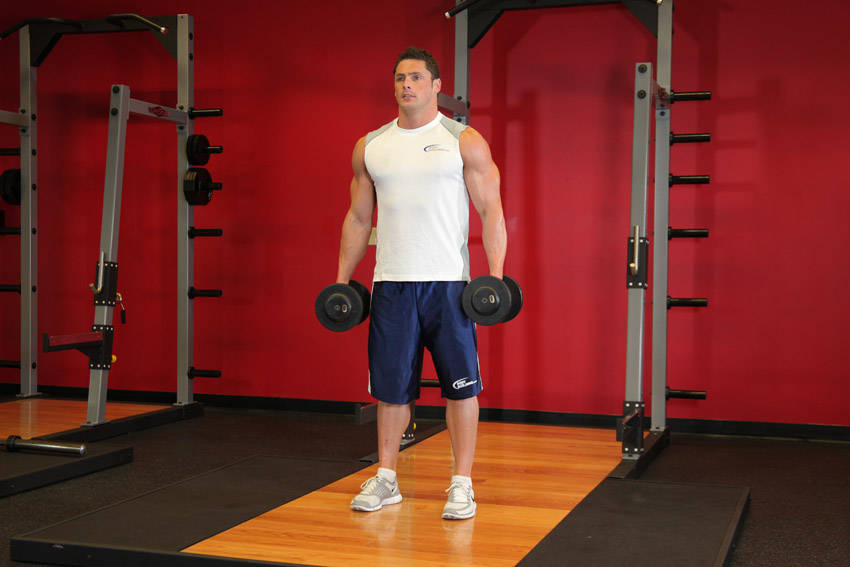
- Stand tall holding a dumbbell in each hand at your sides, palms facing your legs.
- Set your feet shoulder width apart with your toes turned out slightly, keeping your head up and back straight; this is your starting position.
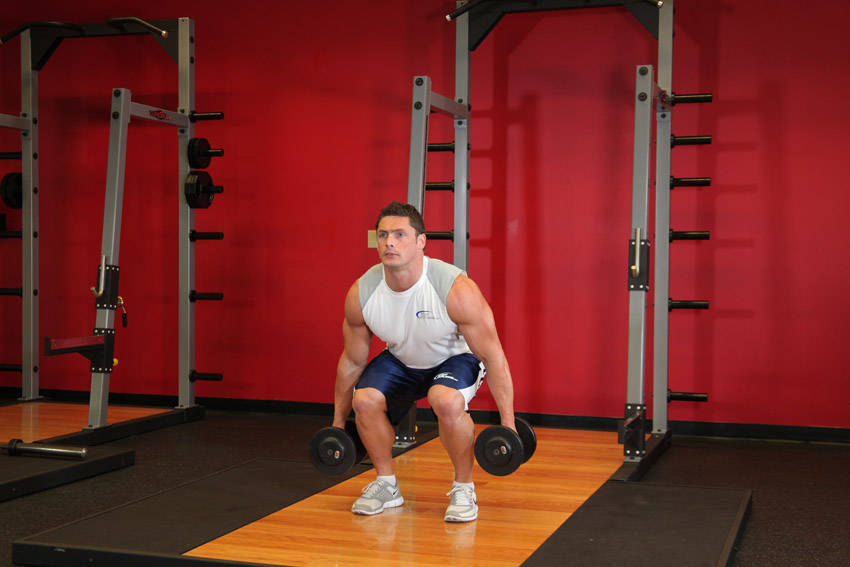
- Bend your knees and hips together, lowering your torso while keeping a straight posture.
- Continue down until your thighs are roughly parallel to the floor, keeping your knees tracking over your toes.
- Push through your heels to stand back up as you exhale, straightening your legs fully.
- Repeat for the rest of your set, keeping the same controlled pace on the way down and up.
Original library instructions (5 steps)
- Stand up straight while holding a dumbbell on each hand (palms facing the side of your legs).
- Position your legs using a shoulder width medium stance with the toes slightly pointed out. Keep your head up at all times as looking down will get you off balance and also maintain a straight back. This will be your starting position. Note: For the purposes of this discussion we will use the medium stance described above which targets overall development; however you can choose any of the three stances discussed in the foot stances section.
- Begin to slowly lower your torso by bending the knees as you maintain a straight posture with the head up. Continue down until your thighs are parallel to the floor. Tip: If you performed the exercise correctly, the front of the knees should make an imaginary straight line with the toes that is perpendicular to the front. If your knees are past that imaginary line (if they are past your toes) then you are placing undue stress on the knee and the exercise has been performed incorrectly.
- Begin to raise your torso as you exhale by pushing the floor with the heel of your foot mainly as you straighten the legs again and go back to the starting position.
- Repeat for the recommended amount of repetitions.
Common mistakes
- Letting the knees collapse inward as you rise; push them out in line with your toes.
- Rounding the back during the descent; keep your chest up and core braced throughout.
- Rising onto the toes at the bottom; keep your weight through your whole foot, especially the heels.
- Choosing dumbbells too heavy to control through a full range; use a lighter pair while you learn the pattern.
Sets and reps by goal
| Goal | Sets, reps and rest |
|---|---|
| Strength | 3 to 4 sets of 6 to 10 reps, 90 seconds to 2 minutes rest |
| Muscle | 3 to 4 sets of 10 to 15 reps, 60 to 90 seconds rest |
| Endurance | 2 to 3 sets of 15 to 20 reps, 45 seconds rest |
Ranges, not prescriptions. Start at the low end and add a set or a rep when every set feels controlled.
Tips
- Keep your head up and gaze forward throughout the squat, which helps keep your back in a strong position.
- Practice the movement with light dumbbells first to build confidence with the depth and knee position.
In the app: this exercise is one of 873 in GymPilot's library, with the same photos, form cues and a link back to the moment in an imported video it came from.
Questions
Is the dumbbell squat good for beginners?
Yes, it is often used as an easier way to learn the squat pattern before adding a barbell.
Dumbbell squat vs barbell squat, which is better?
Both build the legs well. The dumbbell version is easier to learn and gentler on the back, while a barbell allows heavier loading as strength builds.