
Blog · muscles
Best Exercises for Every Muscle Group
· GymPilot Team
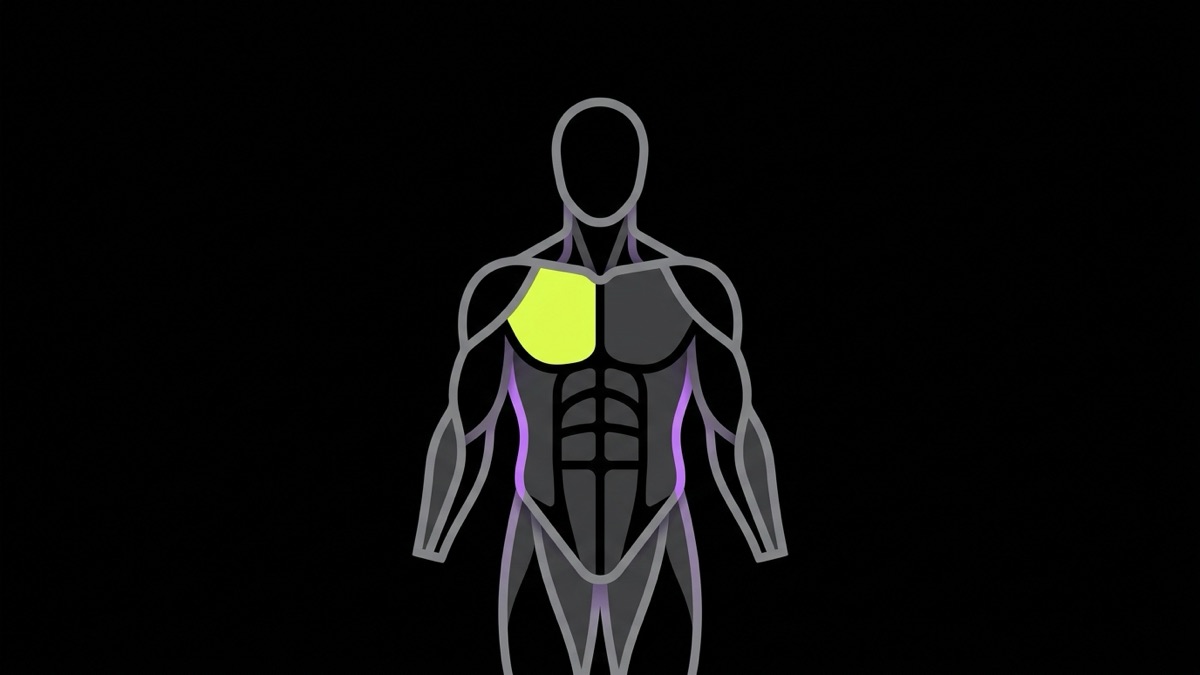
Picking the right exercises for each muscle group is most of what separates a workout that actually builds strength and size from one that just leaves you tired. This guide walks through the best exercises for chest, back, shoulders, legs, arms and core, one muscle group at a time, with the sets, reps and rest that make each one work, plus a quick reference table you can come back to whenever you are planning a session.
Key takeaways
- Every muscle group has a small handful of compound exercises that should anchor most sessions, with isolation work added around them.
- Compound exercises train several muscle groups in one movement, which is why a well built session rarely needs more than two or three exercises per muscle group.
- Sets, reps and rest should always be ranges, not fixed numbers: "3 to 4 sets of 8 to 12 reps, 60 to 90 seconds rest" leaves room for how you feel that day.
- Weekly volume per muscle group matters more than any single session; most hypertrophy training lands somewhere between 10 and 20 total sets a week per muscle group.
- A few advanced movements train several muscle groups at once and do not fit neatly under a single heading, which is worth knowing before you try them.
How to choose exercises for each muscle group
Before the muscle by muscle breakdown, it helps to know what you are actually optimizing for. Every exercise is either a compound movement, one that moves more than one joint and recruits several muscles at once, or an isolation movement, one that targets a single muscle through a single joint. A squat is compound: it trains the quads, glutes and lower back together. A leg extension is isolation: it targets the quads on their own.
A well built session leans on compound exercises for each major muscle group first, since they are the most efficient use of your time and typically allow the most load. Isolation exercises get added afterward to bring up anything that needs extra direct work, or to finish a muscle group off once the bigger compound lift has already been done. Neither approach is complete on its own: compound-only training can leave smaller muscles under-trained relative to the bigger movers, while isolation-only training misses the strength and coordination benefits of a loaded compound lift.
Sets, reps and rest should always be written as ranges rather than single numbers, because how many reps you actually get on a given day depends on sleep, stress and how recovered you are, not just what a plan says on paper. "3 to 4 sets of 8 to 12 reps, 60 to 90 seconds rest" is a specification you can hit even on an off day; "4 sets of 10 reps" is a specification you either hit exactly or feel like you failed, which is a worse way to build a habit that lasts.
Chest exercises
The chest responds well to a mix of pressing angles, since a flat press, an incline press and a fly-style movement each stress the muscle slightly differently. Dumbbell Bench Press for 3 to 4 sets of 8 to 12 reps, 90 seconds rest, is a solid flat-press anchor that also asks more of your stabilizing muscles than a barbell press does, since each arm moves independently. Incline Dumbbell Press for 3 sets of 8 to 12 reps, 90 seconds rest, shifts more of the work toward the upper chest and front shoulders.
Add Cable Chest Press for 2 to 3 sets of 10 to 12 reps, 60 to 90 seconds rest, when you want a guided pressing pattern that keeps constant tension on the chest through the full range of motion, which a free weight press loses near the top of the lift. Two pressing exercises plus one guided finisher covers most of what a chest day needs without turning into an hour of nearly identical sets.
Back exercises
Back training splits into two directions: rows, which pull the shoulder blades together, and pulldowns or pull-ups, which pull the arms down toward the body. Both directions belong in a well rounded routine. Bent Over Barbell Row for 3 to 4 sets of 8 to 12 reps, 90 seconds rest, is a strong horizontal-pull anchor, and Seated Cable Rows for 3 sets of 10 to 12 reps, 60 to 90 seconds rest, adds a second horizontal-pull option with a more controlled path.
For the vertical pull, Wide-Grip Lat Pulldown for 3 sets of 10 to 12 reps, 60 to 90 seconds rest, targets the lats through a long range of motion without needing the pull-up strength a bodyweight version demands. The full breakdown on grip width, form cues and how to build a session around this single movement is in Lat Pulldown: Grips, Form and Programming, if pulldown work is the piece of your back training you want to get right first.
Shoulder exercises
Shoulders are three muscles working as one name: front, side and rear deltoids, and a complete shoulder routine touches all three rather than only pressing. Standing Dumbbell Press for 3 sets of 8 to 10 reps, 60 to 90 seconds rest, trains the front and side deltoids together as a compound anchor and also asks your core to stabilize the weight overhead.
Standing Dumbbell Upright Row for 2 to 3 sets of 10 to 12 reps, 60 seconds rest, brings in more side-deltoid and upper-trap work through a pulling pattern rather than a press. Rear deltoids are easy to under-train because they rarely show up in a pressing movement, so a dedicated rear-delt or rowing-style finisher is worth adding once the front and side work is done for the day.
Leg exercises
Legs cover the largest total muscle mass in the body, split across quads, hamstrings, glutes and calves, which is why a single leg exercise almost never covers everything on its own. Barbell Squat for 3 to 4 sets of 6 to 10 reps, 90 to 120 seconds rest, is the standard quad-dominant anchor, training the glutes and lower back as secondary movers in the same lift.
Romanian Deadlift for 3 sets of 8 to 10 reps, 90 to 120 seconds rest, shifts the emphasis to the hamstrings and glutes through a hip-hinge pattern rather than a knee-dominant squat pattern, and the two together cover most of the lower body's major movement patterns. For a glute-focused finisher, a hip thrust variation isolates the glutes more directly than either the squat or the deadlift manage on their own; the full loading and programming details are in Hip Thrust: Form, Loading and a Glute Program.
For anyone whose lower back tends to round on a conventional deadlift, the trap bar changes the bar path enough to make heavy pulling feel more accessible without losing the hip-hinge benefit. Trap Bar Deadlift: Why It Suits Most Lifters explains why that shift in bar position matters and how to program the lift. Finish leg day with Standing Dumbbell Calf Raise for 2 to 3 sets of 12 to 15 reps, 45 to 60 seconds rest, since calves rarely get trained directly by anything else on this list.
Arm exercises
Biceps and triceps both respond well to isolation work, since neither is usually the primary target of a big compound lift even though both get some indirect work from pressing and pulling. Cross Body Hammer Curl for 2 to 3 sets of 10 to 12 reps, 45 to 60 seconds rest, trains the biceps through a neutral grip that also brings in the forearm more than a standard curl does.
For triceps, Bench Dips for 2 to 3 sets of 10 to 15 reps, 60 seconds rest, is a bodyweight option that needs nothing but a bench, making it an easy addition to almost any session regardless of what equipment the rest of the day used. Arms respond to frequency as much as volume, so two shorter arm-focused blocks across the week often outperform one long one.
Core exercises
Core training is less about a single "ab exercise" and more about the muscles that keep your spine stable while everything else moves. Cross-Body Crunch for 2 to 3 sets of 15 to 20 reps, 45 seconds rest, trains the front and rotational muscles of the abdomen directly. Plank for 2 to 3 sets of 30 to 45 seconds, 45 seconds rest, trains the same muscles isometrically, which carries over well to how the core actually works during a heavy squat or deadlift: holding position under load rather than moving through a range of motion.
Exercises for each muscle group at a glance
| Muscle group | Anchor exercise | Equipment | Sets and reps |
|---|---|---|---|
| Chest | Dumbbell Bench Press | Dumbbells | 3 to 4 sets of 8 to 12 reps |
| Back | Bent Over Barbell Row | Barbell | 3 to 4 sets of 8 to 12 reps |
| Shoulders | Standing Dumbbell Press | Dumbbells | 3 sets of 8 to 10 reps |
| Legs (quads) | Barbell Squat | Barbell | 3 to 4 sets of 6 to 10 reps |
| Legs (hamstrings and glutes) | Romanian Deadlift | Barbell | 3 sets of 8 to 10 reps |
| Arms | Cross Body Hammer Curl | Dumbbells | 2 to 3 sets of 10 to 12 reps |
| Core | Plank | Bodyweight | 2 to 3 sets of 30 to 45 seconds |
Rest between 45 and 120 seconds depending on the exercise: heavier compound lifts on the longer end, lighter isolation and core work on the shorter end.
Advanced movements that cross muscle groups
Not every useful exercise sorts cleanly into one row of the table above. Some of the most demanding movements in the exercise library train several muscle groups at once as a single, coordinated skill rather than as a targeted lift for one area. Muscle Up combines a pulling movement with a pressing movement in one continuous motion, asking the back, shoulders, chest and arms to work together rather than in sequence. Kipping Muscle Up adds a hip-driven swing to that same skill, which shifts some of the demand toward timing and core control rather than pure upper body strength. Muscle Snatch is a barbell movement that trains the whole posterior chain, shoulders and arms together in one fast pull from the floor to overhead.
None of these belong in a first month of training, and none of them replace the muscle by muscle work above. They are worth knowing about because they show the other end of the spectrum from targeted isolation work: exercises that trade precision for total-body coordination, useful once the individual muscle groups behind them are already reasonably strong on their own.
How often to train each muscle group
Picking the right exercises matters less if a muscle group only sees them once every week and a half. Most research-adjacent guidance and most coaching practice agree that training each muscle group roughly twice a week produces better results than training it once, provided the total weekly volume stays similar either way. A muscle group trained once a week with 15 sets in a single session and one trained twice a week with about 7 to 8 sets each time can land at a similar weekly total, but the twice-weekly version usually holds form better in the later sets, since fewer sets are being asked of already-fatigued muscle in any single session.
This is part of why splits like upper lower and push pull legs are so common: they naturally spread each muscle group across two sessions a week instead of concentrating it into one. A bro split, which trains one muscle group per day, can still work well, but it depends more heavily on that single weekly session being high quality, since there is no second pass at the same muscle group until a full week has passed.
None of this means more frequency is automatically better without limit. Training a muscle group so often that every session starts with residual soreness from the last one is a sign the frequency has outrun recovery, not a sign to push harder. The right frequency for a given muscle group is whatever lets you show up to the next session for it able to move real weight with good form, not sore enough that the first several reps are compromised.
Building a session from these exercises
A full session usually needs one or two exercises per muscle group it targets, not five. A push day built from this guide might pair the chest press with a shoulder press and a triceps finisher; a pull day might pair the row with the pulldown and a biceps finisher; a leg day might pair the squat with the Romanian deadlift, a hip thrust variation and a calf raise. Core work fits at the end of almost any session, since it rarely needs to be fresh the way a heavy compound lift does.
However you split the muscle groups across your week, save the exercises you land on in GymPilot so you are not rebuilding the list from memory every time you walk into the gym: try GymPilot.
Fitness content on this page is general information, not medical advice: consult a professional if you have a condition or injury.
Questions
How many exercises do I need for each muscle group?
One or two per session is usually enough. A single compound movement like a squat or a row already recruits several muscles at once, so a full session covering a muscle group rarely needs more than two or three exercises for it.
Should I do compound or isolation exercises first?
Compound exercises first, while you are freshest. A barbell squat or a bench press asks more of your coordination and your whole body than a single-joint isolation movement does, so it belongs earlier in the session.
Do I need different exercises for muscle size versus strength?
Not fundamentally. The same exercises build both size and strength; what typically changes between the two goals is the rep range and how close to failure you train, not which exercises for each muscle group you pick.
Can one exercise train more than one muscle group?
Yes, and most of the best exercises do. A bent over row trains the back as a primary mover and the biceps and rear shoulders as secondary movers in the same set, which is part of why compound lifts are efficient.
What if I only have time to train a few muscle groups per session?
Group them sensibly rather than skipping any long term. A push, pull, legs or upper lower split spreads muscle groups across different days, so every one still gets trained across the week even if not every session.