Tate Press
A dumbbell triceps exercise done lying on a bench, lowering the dumbbells to your chest with your elbows pointed out. It is an unusual angle that hits the triceps hard once you learn the motion.
How to do the tate press
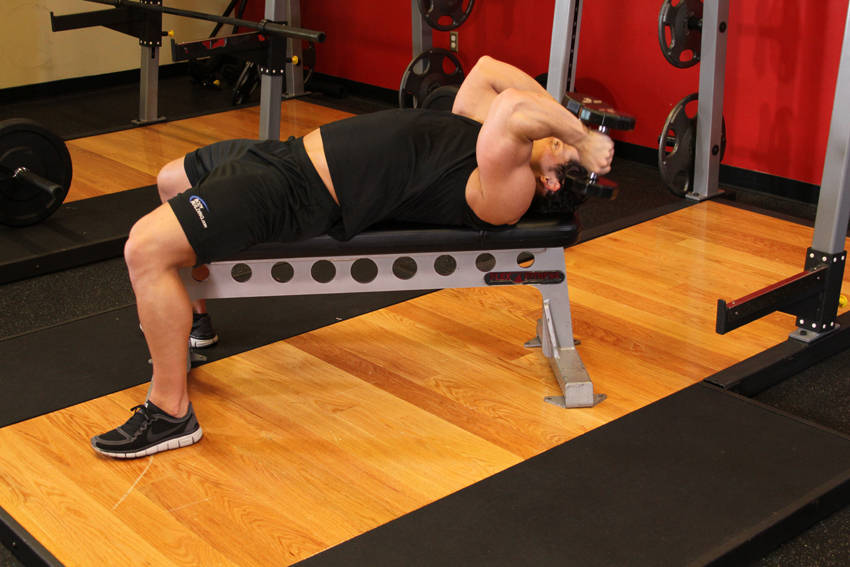
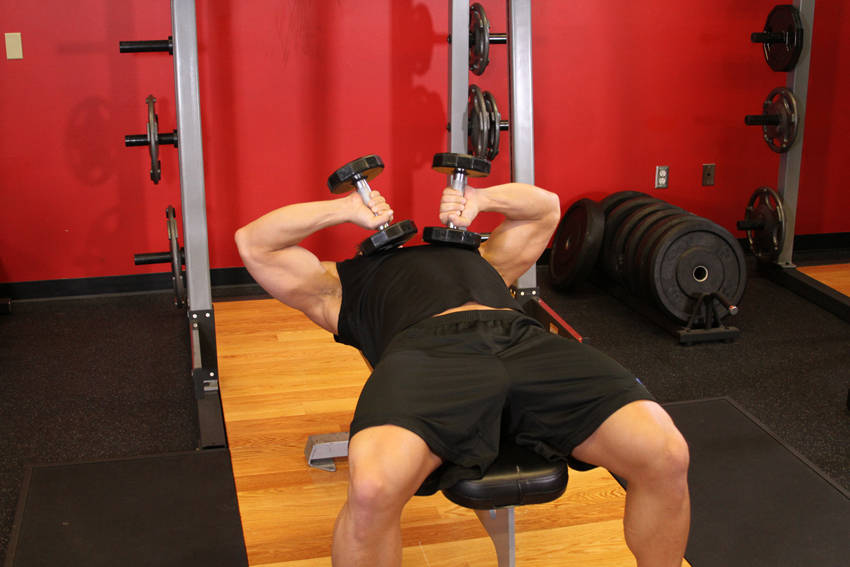
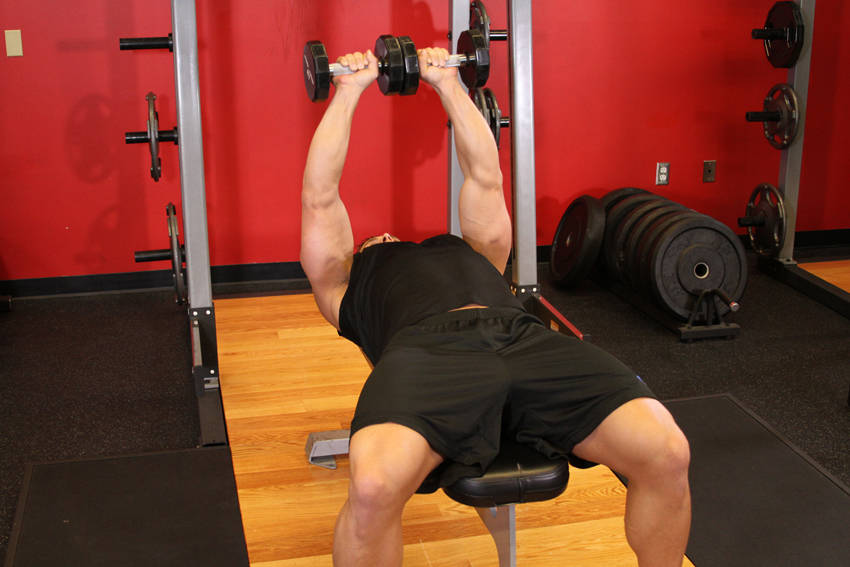
- Lie on a flat bench holding a dumbbell in each hand above your chest, palms facing each other.
- Set your arms wider than shoulder width with your elbows pointed out to the sides.
- Keep your upper arms still and slowly lower the dumbbells in toward your chest.
- Stop just before the dumbbells touch your upper chest, keeping full control the whole way.
- Use your triceps to press the dumbbells back up along the same path.
- Lock out at the top briefly, then repeat for the rest of your set.
Original library instructions (5 steps)
- Lie down on a flat bench with a dumbbell in each hand on top of your thighs. The palms of your hand will be facing each other.
- By using your thighs to help you get the dumbbells up, clean the dumbbells one arm at a time so that you can hold them in front of you at shoulder width. Note: when holding the dumbbells in front of you, make sure your arms are wider than shoulder width apart from each other using a pronated (palms forward) grip. Allow your elbows to point out. This is your starting position.
- Keeping the upper arms stationary, slowly move the dumbbells in and down in a semi circular motion until they touch the upper chest while inhaling. Keep full control of the dumbbells at all times and do not move the upper arms nor rest the dumbbells on the chest.
- As you breathe out, move the dumbbells up using your triceps and the same semi-circular motion but in reverse. Attempt to keep the dumbbells together as they move up. Lock your arms in the contracted position, hold for a second and then start coming down again slowly again. Tip: It should take at least twice as long to go down than to come up.
- Repeat the movement for the prescribed amount of repetitions of your training program.
Common mistakes
- Letting the upper arms move during the lowering phase; keep them fixed and let only the elbows bend.
- Rushing the lowering phase; a slower descent here trains the triceps more effectively than a fast one.
- Resting the dumbbells on your chest between reps, which takes tension off the muscle.
- Using dumbbells too heavy to control near your face; start lighter than your regular triceps exercise.
Sets and reps by goal
| Goal | Sets, reps and rest |
|---|---|
| Strength | 3 to 4 sets of 6 to 8 reps, 90 seconds rest |
| Muscle | 3 to 4 sets of 8 to 12 reps, 60 to 90 seconds rest |
| Endurance | 2 to 3 sets of 12 to 15 reps, 45 to 60 seconds rest |
Ranges, not prescriptions. Start at the low end and add a set or a rep when every set feels controlled.
Tips
- Practice the motion with very light dumbbells first, since the elbows out angle feels unusual at first.
In the app: this exercise is one of 873 in GymPilot's library, with the same photos, form cues and a link back to the moment in an imported video it came from.
Questions
Is the Tate press good for beginners?
It takes a bit of practice to get comfortable with the elbows out position, so beginners should start with light dumbbells and focus on control.
What muscles does the Tate press work?
It mainly targets the triceps, with the chest and shoulders assisting to stabilize the dumbbells through the lowering and pressing phases.