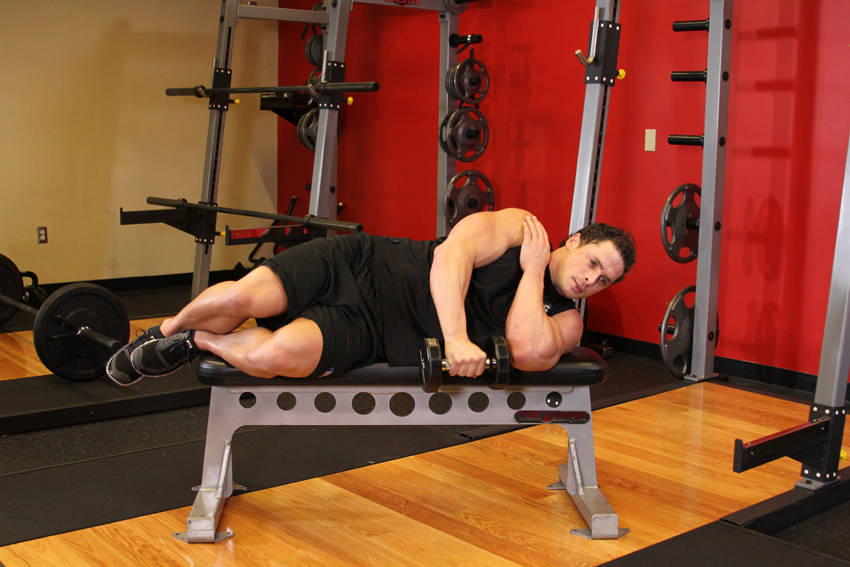
External Rotation
A lying dumbbell exercise that rotates the forearm upward from a bent elbow position, targeting the small muscles at the back of the shoulder. It suits beginners looking to add shoulder stability work.
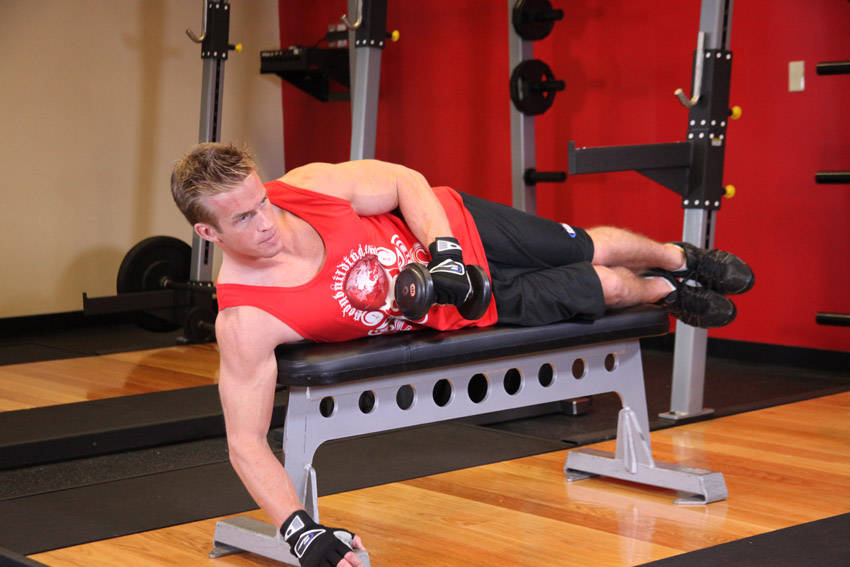
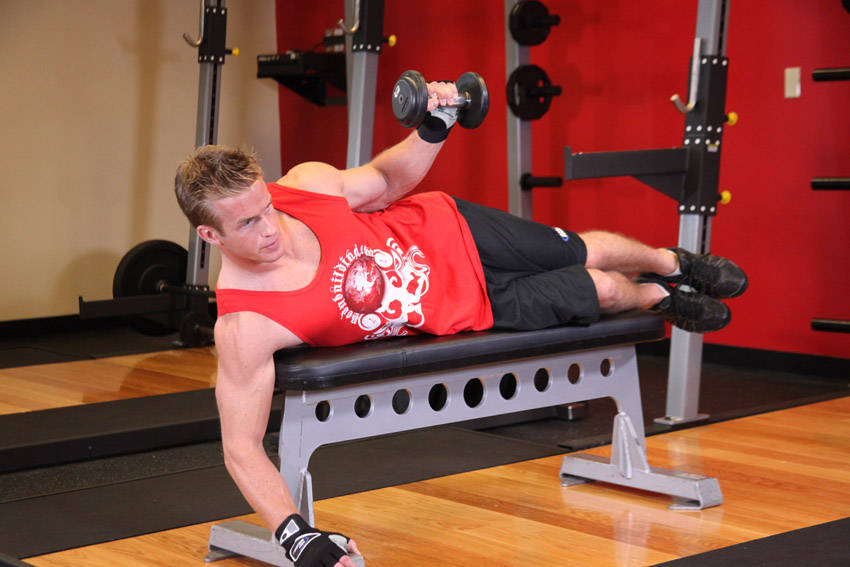
How to do the external rotation
- Lie on your side on a flat bench, holding a dumbbell in the arm on top.
- Bend your elbow to a right angle so your forearm points across your body, upper arm resting against your torso.
- Rotate your forearm upward, lifting the dumbbell while your upper arm stays against your side.
- Continue until your forearm points toward the ceiling, exhaling as you rotate.
- Lower the dumbbell back down slowly as you inhale, then switch sides after your set.
Original library instructions (6 steps)
- Lie sideways on a flat bench with one arm holding a dumbbell and the other hand on top of the bench folded so that you can rest your head on it.
- Bend the elbows of the arm holding the dumbbell so that it creates a 90-degree angle between the upper arm and the forearm. Tip: Keep the arm parallel to your torso.
- Now bend the elbow while keeping the upper arm stationary. In this manner, the forearm will be parallel to the floor and perpendicular to your torso (Tip: So the forearm will be directly in front of you). The upper arm will be stationary by your torso and should be parallel to the floor (aligned with your torso at all times). This will be your starting position.
- As you breathe out, externally rotate your forearm so that the dumbbell is lifted up in a semicircle motion as you maintain the 90 degree angle bend between the upper arms and the forearm. You will continue this external rotation until the forearm is perpendicular to the floor and the torso pointing towards the ceiling. At this point you will hold the contraction for a second.
- As you breathe in, slowly go back to the starting position.
- Repeat for the recommended amount of repetitions and then switch to the other arm.
Common mistakes
- Letting the upper arm lift away from the torso, which turns the rotation into more of a raise.
- Using a dumbbell that is too heavy for the small muscles this exercise targets.
- Rushing the movement instead of rotating slowly through the full range.
Sets and reps by goal
| Goal | Sets, reps and rest |
|---|---|
| Strength | 3 sets of 10 to 12 reps per arm, 45 to 60 seconds rest |
| Muscle | 3 sets of 12 to 15 reps per arm, 45 seconds rest |
| Endurance | 2 to 3 sets of 15 to 20 reps per arm, 30 seconds rest |
Ranges, not prescriptions. Start at the low end and add a set or a rep when every set feels controlled.
Tips
- Use a light dumbbell, since this exercise trains smaller muscles than a typical shoulder press or raise.
- Rest your head on your free arm or a pad to keep your neck comfortable throughout the set.
In the app: this exercise is one of 873 in GymPilot's library, with the same photos, form cues and a link back to the moment in an imported video it came from.
Questions
Is the external rotation exercise good for beginners?
Yes. It uses a light weight and a small range of motion, making it a gentle way to add shoulder stability work to a routine.
What muscles does the external rotation exercise work?
It mainly works the shoulders, since this record does not list any secondary muscles for the exercise.