
Blog · muscles
Lat Pulldown: Grips, Form and Programming
· GymPilot Team
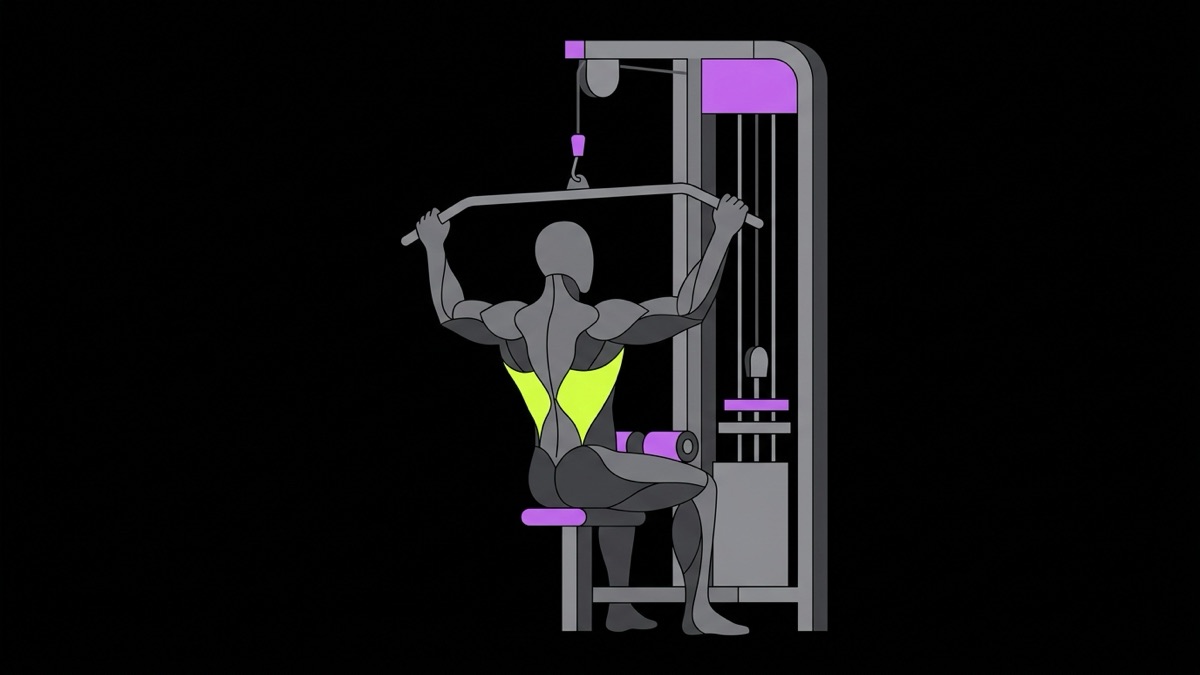
The lat pulldown is one of the most reliable ways to build a wider, stronger back without needing to do a strict pull-up, since a cable stack lets you dial in an exact weight instead of moving your full bodyweight. This guide covers the grips worth knowing, the form cues that keep the movement in your back instead of your arms, and how to fit the lat pulldown into a program built around any goal.
Key takeaways
- The lat pulldown trains the lats, the middle back and the biceps together, using a cable and a bar instead of your full bodyweight.
- Grip width and hand position change which part of the back gets the most emphasis, but every grip still trains the same core pulling pattern.
- Pulling the bar to the upper chest with your torso mostly upright is safer and more consistent than leaning far back or pulling behind the neck.
- The lat pulldown fits well as either a main pulling movement or an accessory alongside rows and pull-ups.
- Three to 4 sets of 8 to 12 reps covers most goals, with heavier, lower rep sets suiting strength-focused blocks.
What the lat pulldown actually trains
The lat pulldown's main target is the latissimus dorsi, the broad muscle that runs down the sides of your back and gives a trained back its width. Alongside the lats, the movement pulls in the middle back muscles between your shoulder blades and finishes with real work for the biceps, since bending the elbow is part of every rep regardless of grip. That combination is why the lat pulldown shows up in nearly every well built back day, whether the rest of the session leans on rows, pull-ups or both.
Because the resistance comes from a stack of plates on a cable rather than your own bodyweight, the lat pulldown lets you select a weight that is genuinely appropriate for where your pulling strength is right now. That makes it a useful entry point for anyone who cannot yet complete a strict pull-up, and a useful accessory for lifters who already can, since it allows extra pulling volume without adding more sets of a much harder bodyweight movement.
Lat pulldown grips compared
Different grips and attachments shift the lat pulldown's emphasis slightly without changing the basic pattern. Choosing between them comes down to what you want more of that session, back width, biceps involvement or a variation that is easier on the shoulders.
| Grip or attachment | Primary emphasis | Good for |
|---|---|---|
| Wide grip, palms forward | Upper lats and back width | Lifters chasing a wider looking back |
| Close or V-bar grip | Lower lats and mid back | Lifters who want less strain on the shoulders |
| Underhand grip | Lats plus more biceps involvement | Finishing a pulling day with extra arm work |
| One arm attachment | Each side worked independently | Fixing a left to right strength imbalance |
| Straight arm attachment | Lats with minimal elbow bend | Isolating the lats without much bicep work |
Wide-Grip Lat Pulldown for 3 to 4 sets of 8 to 12 reps, 60 to 90 seconds rest, is the standard version most programs default to first. Close-Grip Front Lat Pulldown for 3 sets of 10 to 12 reps, 60 to 90 seconds rest, narrows the grip and shifts some emphasis toward the lower lats. One Arm Lat Pulldown for 2 to 3 sets of 10 to 12 reps per side, 60 seconds rest, is worth adding whenever one side of your back consistently feels weaker or more fatigued than the other.
Straight-Arm Pulldown for 3 sets of 12 to 15 reps, 45 to 60 seconds rest, and Rope Straight-Arm Pulldown for 3 sets of 12 to 15 reps, 45 to 60 seconds rest, both keep the elbows nearly straight throughout the rep, isolating the lats with much less biceps involvement than the standard version. Either works well as a finisher after the main pulling exercise for the day is done.
Getting the form right
Start seated with your thighs locked under the pads and the bar set wide enough that your grip sits just outside shoulder width for the standard version. Lean back only slightly, a few degrees at most, and pull the bar down toward your upper chest by driving your elbows down and back rather than by yanking with your arms. The moment your torso starts swinging noticeably to help the bar move, or your shoulders shrug up toward your ears, the working weight has crept past what your back alone can control.
Pulling the bar to the front of your chest, rather than behind your neck, is the safer default for most people, since a behind-the-neck pull asks your shoulders for a range of rotation that many lifters do not have without discomfort. Save that variation, if you use it at all, for lifters with genuinely mobile, pain-free shoulders who already move well on the standard front pulldown. A brief pause at the bottom of each rep, feeling your back muscles fully contracted before letting the bar rise back up under control, does more for building the mind to muscle connection here than pulling fast and swinging the weight down.
Programming the lat pulldown into your split
For general muscle building, 3 to 4 sets of 8 to 12 reps with 60 to 90 seconds rest fits most back days well, whether the lat pulldown is your main pulling movement or paired alongside a row. Strength-focused blocks can shift toward 4 sets of 5 to 8 reps with closer to 120 seconds rest, using a heavier working weight than the higher rep ranges above allow.
The lat pulldown pairs naturally with a horizontal row on the same day, since the pulldown's vertical pulling angle and a row's horizontal angle train the back from two different directions rather than repeating the same line of pull twice. A typical back day might open with a row for strength, then move to two or three lat pulldown variations from the table above to round out the session's total back volume.
Common lat pulldown mistakes
The most common mistake is picking a weight heavy enough that the only way to move it is to lean back sharply and use momentum from the torso rather than pulling with the back. A useful check is to watch whether your torso angle stays roughly the same from the first rep of a set to the last; if it starts leaning back further as the set goes on, the weight has outpaced what your lats can control on their own.
A second mistake is letting the bar stop short of the chest on every rep, which trims the range of motion and leaves some of the exercise's benefit on the table. A full rep brings the bar down to roughly chest height with the elbows finishing behind the torso, then lets the weight rise back up in a controlled line until the arms are fully extended and the lats feel stretched at the top.
A third mistake is training the lat pulldown with the same grip and rep range every single session for months. Rotating between a wide grip, a close grip and an underhand grip across different weeks, or simply changing the rep range every few weeks, keeps the back responding without needing to change the exercise itself.
Lat pulldown versus a pull-up
Both movements pull your body or a bar along a similar vertical line and train largely the same muscles, so the choice between them often comes down to where your pulling strength currently sits. The lat pulldown lets you select any weight up to and beyond your bodyweight, which makes it far easier to find a challenging but completable rep range from week one. A pull-up asks you to move your entire bodyweight every rep, which can be too much for a true beginner and not quite enough of a challenge for a very strong, experienced lifter without added weight.
Many programs use both across a week rather than choosing one permanently: pull-ups as the harder, bodyweight-based movement early in a session while you are freshest, and the lat pulldown afterward as a way to add more controlled pulling volume once fatigue makes strict pull-ups harder to complete with good form.
Where the lat pulldown fits in a full training week
The lat pulldown is one entry in a much larger set of movements worth knowing for every major muscle group. Best Exercises for Every Muscle Group is the hub for that full list if you are building a program from scratch rather than adding a single exercise to an existing one. Trap Bar Deadlift: Why It Suits Most Lifters and Hip Thrust: Form, Loading and a Glute Program cover the lower body side of a balanced week, while Chest Isolation Exercises: Finish Every Push Day rounds out the pushing muscles that a back-focused day like this one is meant to balance against.
Once you have picked the grips and rep ranges that suit your back day, save the exercises and their sets, reps and rest in GymPilot so the next session is ready without rebuilding the plan from memory: try GymPilot.
Fitness content on this page is general information, not medical advice: consult a professional if you have a condition or injury.
Questions
Is the lat pulldown as good as pull-ups?
Both train the same general pulling pattern and the same main muscles. The lat pulldown lets you set an exact weight below your bodyweight, which makes it easier to build up to a first pull-up. Pull-ups ask you to move your full bodyweight, which some lifters find harder to load precisely.
Which lat pulldown grip is best for width?
A wide grip pulldown, taken to the upper chest, tends to emphasize the width of the back more than a close or underhand grip does. A close or underhand grip still trains the lats but brings the biceps and lower lats into the movement more directly.
Should I pull the lat pulldown bar behind my neck?
A pulldown taken to the front of the chest is the safer default for most shoulders, since it does not ask for the same range of shoulder rotation a behind-the-neck pull requires. Save a behind-the-neck variation for lifters with mobile, healthy shoulders who already have solid form on the standard version.
How heavy should I go on the lat pulldown?
Heavy enough that the last couple of reps in a set feel genuinely hard, without your torso swinging back to help the bar down or your shoulders shrugging up toward your ears. If either of those shows up before your working reps are done, the weight is too heavy for clean form.
What is GymPilot?
GymPilot is an iPhone app by Viral Labs that turns a public workout link from TikTok, Instagram, YouTube or Facebook into a structured workout with exercises, sets, reps and rest, which you can save, schedule and train from. It also includes an 873-exercise library and an AI program builder.
Is GymPilot free?
Yes. The free version includes 5 imports a month and 1 collection. GymPilot Pro removes those limits and is sold monthly or yearly through the App Store.
Does GymPilot download videos?
No. GymPilot reads only what a public post makes visible, such as the caption, slides and transcript, and it does not download the video, work on private posts, or bypass any platform restriction.