
Blog · muscles
Trap Bar Deadlift: Why It Suits Most Lifters
· GymPilot Team
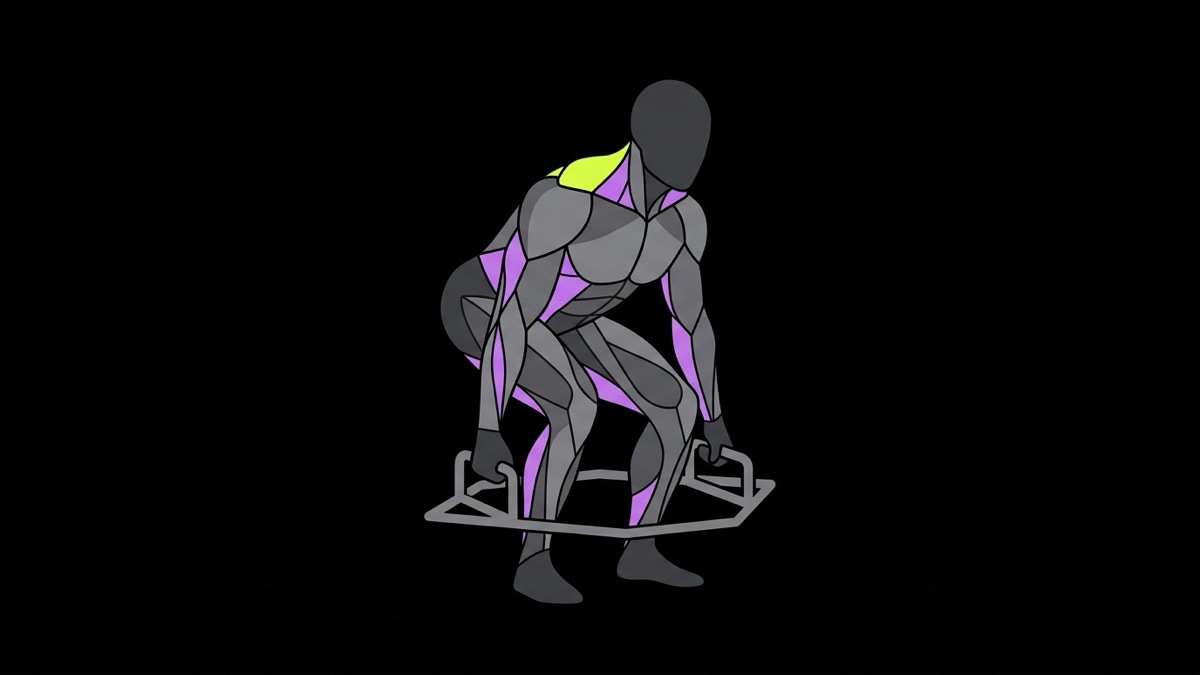
The trap bar deadlift has become the default deadlift variation many coaches recommend first, and for good reason: standing inside a hexagonal bar changes the mechanics of the lift just enough to suit a wider range of bodies and experience levels than a standard barbell deadlift does. This guide covers what the trap bar deadlift trains, how it compares to a barbell deadlift, and how to fit it into a program that already includes other hinge and squat patterns.
Key takeaways
- The trap bar deadlift trains the quads, glutes and hamstrings together, with real support work from the upper back and grip.
- Standing inside the bar centers the load and allows a more upright torso than a standard barbell deadlift.
- The trap bar deadlift is a common first choice for beginners learning a hinge pattern, since the neutral grip and bar path are easier to pick up.
- Three sets of 5 to 8 reps suits strength goals; 3 sets of 8 to 10 reps suits general muscle building.
- A trap bar is required equipment; without one, a Barbell Deadlift or Romanian Deadlift trains similar muscles.
What the trap bar deadlift actually trains
Trap Bar Deadlift is a hinge and squat hybrid that pulls significant work from the quads, glutes and hamstrings all in the same rep. Because you stand inside the hexagonal bar rather than in front of it, your knees bend a bit more than they would in a standard barbell deadlift, which shifts a noticeable share of the work toward the quads while the glutes and hamstrings still handle most of the hip extension. The upper back, forearms and core all work isometrically throughout the set to keep your posture solid and the bar from drifting away from your body.
That blend of squat and hinge mechanics is part of why the trap bar deadlift gets recommended so often as a general strength builder rather than a specialist tool for one specific muscle group. It trains a large share of the lower body in a single, fairly natural movement pattern.
Trap bar deadlift versus barbell deadlift
The biggest mechanical difference is where the load sits relative to your body. A barbell sits in front of your shins, which pulls your torso further forward and asks more of your lower back and hamstring flexibility to reach the bar in a safe position. Standing inside a trap bar centers the handles at your sides, which allows a more upright torso and a bar path that tracks straight up through your center of mass instead of around your shins.
That more upright position is why many lifters, especially those with longer torsos or limited hip and hamstring flexibility, find the trap bar deadlift more comfortable to load heavily than a standard Barbell Deadlift. Neither variation is strictly better across the board; the trap bar simply removes some of the technical demands that make a barbell deadlift harder to learn quickly, while the barbell version still has a place for lifters training specifically for a barbell deadlift as a competition lift.
Getting the form right
Step inside the trap bar with your feet roughly hip width apart, positioned so the handles sit level with the middle of your foot. Bend at the hips and knees together to grip the handles, keeping your chest up and your back flat rather than rounded. Push through the floor to stand up, keeping the bar close to your body the entire way and finishing with your hips fully extended, rather than leaning back past straight at the top.
Lower the bar back down by bending at the hips and knees together in reverse of how you stood up, keeping the same flat back position all the way to the floor. A brief reset between reps, rather than bouncing the weight off the floor, keeps each rep starting from a controlled position instead of relying on momentum from the previous one.
Programming the trap bar deadlift
For general strength, 3 sets of 5 to 8 reps with 120 to 150 seconds rest allows a heavier working weight and full recovery between sets. For muscle building goals, 3 sets of 8 to 10 reps with 90 to 120 seconds rest fits a slightly higher volume approach. Because the trap bar deadlift already demands a lot from the whole body, most programs place it early in a leg or full body session, before accessory work like Stiff-Legged Barbell Deadlift for 3 sets of 8 to 10 reps, 90 to 120 seconds rest, which narrows the focus toward the hamstrings once the main lift for the day is done.
If a trap bar is not available, Stiff-Legged Dumbbell Deadlift for 3 sets of 8 to 10 reps, 90 seconds rest, or a standard Romanian Deadlift trains a similar hinge pattern using equipment most gyms already stock.
Who benefits most from this variation
Beginners learning their first hinge pattern often progress faster with a trap bar deadlift than a barbell version, since the neutral grip and centered bar path remove two of the more difficult technical elements to learn at once. Taller lifters and anyone with limited hamstring flexibility frequently find the more upright torso noticeably more comfortable to load heavily. Experienced lifters training specifically for a barbell deadlift as a competition lift still benefit from including the trap bar version as a variation, since it trains much of the same musculature with slightly less cumulative strain on the lower back across a training block.
Where the trap bar deadlift fits in a full training week
The trap bar deadlift is one of many lower body options worth knowing well. Best Exercises for Every Muscle Group is the hub for the full list across every major muscle group. Hip Thrust: Form, Loading and a Glute Program covers a more glute-specific hip-dominant lift to pair alongside it, Lat Pulldown: Grips, Form and Programming rounds out the upper body pulling side of a session, and Chest Isolation Exercises: Finish Every Push Day balances a week that leans heavily on lower body hinge work like this one.
Once you know which deadlift variation fits your goals, save it in GymPilot along with the sets, reps and rest that worked for you, so your next leg day starts exactly where the last one left off: try GymPilot.
Fitness content on this page is general information, not medical advice: consult a professional if you have a condition or injury.
Questions
Is the trap bar deadlift easier than a barbell deadlift?
Many lifters find it more approachable, mainly because the more upright torso and centered bar path ask less of the lower back and hamstrings' flexibility. It is not automatically lighter or less demanding, just a different loading pattern that suits a wider range of body shapes and experience levels.
What muscles does the trap bar deadlift work?
The quads, glutes and hamstrings do most of the work, with real support from the upper back, grip and core to keep the bar under control through the whole rep. Because the hips and knees bend more than in a standard deadlift, the quads take on a bit more of the load.
Can beginners start with a trap bar deadlift?
Yes, it is a common recommendation for a first hinge or squat pattern, since the neutral hand position and centered bar path are easier to learn than a barbell deadlift's grip and bar path around the shins.
Do I need a trap bar to do this exercise?
Yes, the exercise specifically needs a hexagonal or diamond shaped trap bar, sometimes called a hex bar. If one is not available, a Barbell Deadlift or a Romanian Deadlift trains similar muscles with the equipment most gyms already have.
What is GymPilot?
GymPilot is an iPhone app by Viral Labs that turns a public workout link from TikTok, Instagram, YouTube or Facebook into a structured workout with exercises, sets, reps and rest, which you can save, schedule and train from. It also includes an 873-exercise library and an AI program builder.
Is GymPilot free?
Yes. The free version includes 5 imports a month and 1 collection. GymPilot Pro removes those limits and is sold monthly or yearly through the App Store.
Does GymPilot download videos?
No. GymPilot reads only what a public post makes visible, such as the caption, slides and transcript, and it does not download the video, work on private posts, or bypass any platform restriction.