
Blog · muscles
Leg Curl: Lying vs Seated, and How to Program It
· GymPilot Team
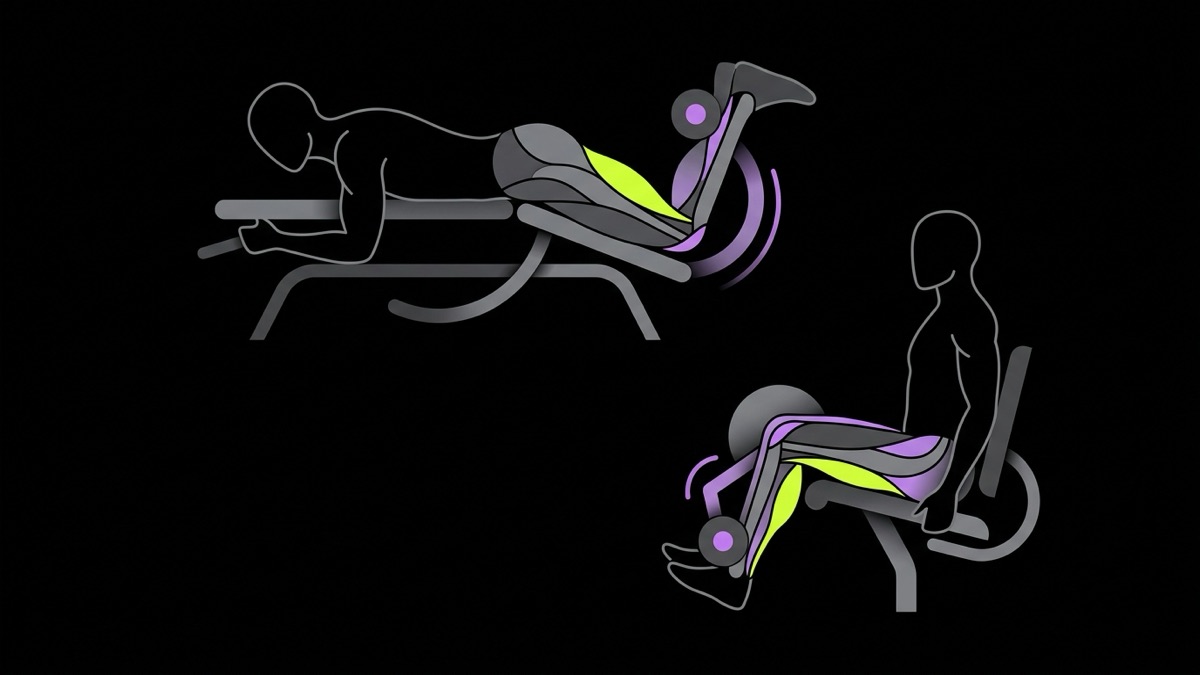
A leg curl is an isolation exercise that bends the knee against resistance, targeting the hamstrings directly without recruiting the quads or glutes the way a squat or lunge does. The two main machine versions, lying and seated, position your hip differently and shift the emphasis slightly, which is worth understanding before you pick one over the other. This guide compares the lying and seated leg curl, covers useful variations, and shows how to program leg curls into a lower body session.
Key takeaways
- A leg curl isolates the hamstrings by bending the knee, without the quad and glute involvement a squat or lunge pattern brings in.
- The lying leg curl trains the hamstrings from a hip-extended position; the seated leg curl trains them from a hip-flexed position, so the two emphasize the muscle slightly differently.
- Leg curls belong after compound lower body lifts like a squat or a Romanian deadlift, once your bigger movements are done.
- 3 sets of 10 to 15 reps, 60 to 90 seconds rest, is a reasonable range for most leg curl programming.
- Standing and single-leg leg curl variations work without a seated or lying machine when equipment is limited.
Lying leg curl vs seated leg curl
The Lying Leg Curls position you face down on a bench with your hip in a neutral or slightly extended position, then you curl a padded lever up toward your glutes by bending your knees. Because your hip stays relatively extended throughout, this version puts the hamstrings under a longer stretch at the bottom of the movement.
The Seated Leg Curl sits you upright with your hip bent to roughly ninety degrees, then you curl the pad down and back by bending your knees against resistance. The flexed hip position in this version shortens the hamstrings slightly at the starting length, which some lifters find lets them feel more direct tension through the mid-range of the movement.
Neither position is objectively superior for building hamstring size or strength. Because they load the muscle from slightly different starting lengths, using the lying version on one lower body day and the seated version on another, or alternating them across training blocks, is a reasonable way to make sure both ranges of the movement get trained over time.
Leg curl variations without a machine
The Standing Leg Curl trains one leg at a time against a cable or band, curling the heel up toward the glute while standing on the working leg. This unilateral setup also demands balance and single-leg stability that the seated and lying machine versions do not ask for, which makes it a useful addition even if you already have access to a machine.
The Seated Band Hamstring Curl uses resistance band tension instead of a stacked-weight machine, which makes it a practical substitute for home training or travel when a leg curl machine is not available. It follows the same seated, hip-flexed setup as the machine version, just with a different resistance source.
Pairing leg curls with quad and lower body work
A leg curl rarely stands alone in a lower body session; it usually pairs with quad-dominant and other lower body work. The Single-Leg Leg Extension trains the quads with a similar isolation approach on the opposite side of the leg, and running both a leg curl and a leg extension in the same session covers the front and back of the thigh with dedicated, single-joint work.
For core stability work that fits well at the end of a lower body day, the Seated Leg Tucks and the Seated Flat Bench Leg Pull-In both train the hip flexors and lower abs through a knee-tuck pattern, closing out a session that already emphasized the hamstrings and quads. A brief Seated Floor Hamstring Stretch after your leg curl sets is a reasonable way to end a lower body session rather than adding more working sets.
Grip and forearm work is worth mentioning too, since many lower body days end with deadlift variations that tax the grip. The Seated Two-Arm Palms-Up Low-Pulley Wrist Curl, the Seated Palms-Down Barbell Wrist Curl, the Seated Palm-Up Barbell Wrist Curl and the Seated One-Arm Dumbbell Palms-Up Wrist Curl all give the forearms direct work at the end of a session, once the bigger lower body lifts are finished.
Programming leg curls into your week
A sensible lower body session leads with a compound movement, a squat or Romanian deadlift pattern, then adds a leg curl as isolation work afterward. 3 sets of 10 to 15 reps with 60 to 90 seconds rest fits most goals, since the joint stress on a leg curl is lower than a heavy compound lift, which tolerates a slightly higher rep range comfortably.
Weekly hamstring volume across your whole week, compound and isolation combined, generally lands well somewhere between 10 and 20 total sets. If your compound lower body lifts already involve a fair amount of hip hinging, one or two leg curl sessions a week, alternating lying and seated versions, is usually enough rather than adding leg curls to every single lower body day.
For the chest and shoulder side of a full body approach, Compound Chest Exercises: The Presses That Build Mass, Chest Isolation Exercises: Finish Every Push Day and Compound Shoulder Exercises: Build Delts Efficiently round out the rest of your training week, and Best Exercises for Every Muscle Group ties every muscle group together in one reference.
Once your lower body day is set, save it in GymPilot and track your leg curl progress from week to week: try GymPilot.
Fitness content on this page is general information, not medical advice: consult a professional if you have a condition or injury.
Questions
Is the lying leg curl or the seated leg curl better?
Neither is better outright. The lying leg curl trains the hamstrings from a hip-extended position and the seated leg curl trains them from a hip-flexed position, so they emphasize the muscle slightly differently. Using both across a week covers the hamstrings more completely than either alone.
How many sets and reps of leg curls should I do?
3 sets of 10 to 15 reps, 60 to 90 seconds rest, is a common range for a leg curl used as an isolation movement after a compound lower body lift like a squat or a Romanian deadlift.
Should leg curls come before or after squats?
After. A squat or a deadlift pattern is a compound movement that recruits the hamstrings along with the quads and glutes, and it demands more coordination and total effort, so it belongs earlier in a session while you are fresh.
Can I do leg curls without a machine?
Yes. A standing single-leg version with a band or cable, or a hamstring curl performed on a stability ball, trains a similar pattern without a seated or lying machine, though the range of motion and resistance curve will feel different.
What is GymPilot?
GymPilot is an iPhone app by Viral Labs that turns a public workout link from TikTok, Instagram, YouTube or Facebook into a structured workout with exercises, sets, reps and rest, which you can save, schedule and train from. It also includes an 873-exercise library and an AI program builder.
Is GymPilot free?
Yes. The free version includes 5 imports a month and 1 collection. GymPilot Pro removes those limits and is sold monthly or yearly through the App Store.
Does GymPilot download videos?
No. GymPilot reads only what a public post makes visible, such as the caption, slides and transcript, and it does not download the video, work on private posts, or bypass any platform restriction.